Dog Tick Collars vs Spot-On Drops: Price and Fix - dog tick collar vs spot on
Finding an engorged tick on your pet triggers instant panic. A single bite can transmit debilitating pathogens like Lyme disease or Ehrlichiosis within twenty-four hours. When choosing between a dog tick collar vs spot on treatment, pet owners need a reliable fix that fits their routine and budget. Weighing the upfront price against real-world protection helps you pick the right defense for your dog's daily lifestyle.
Table of Contents
- Protecting Your Dog: Collars or Topical Treatments for Parasites?
- Mechanisms of Action: How Collars and Spot-Ons Deliver Active Ingredients
- Dog Tick Collar vs Spot On: Speed of Kill and Repellent Power Compared
- Safety Profiles: Multi-Pet Households, Children, and Adverse Reactions
- Longevity and Value: Evaluating 8-Month Wear Against Monthly Dosing
- Which Option Fits Your Dog? A Decision Matrix for Everyday Lifestyles
- Supporting Cellular Immunity and Post-Parasite Recovery with PrimePet Vital Mix
- Creating a Comprehensive Year-Round Defense Plan for Your Dog
Tick-borne diseases destroy healthy blood cells and trigger persistent joint inflammation. Ticks latch onto vulnerable skin folds, feeding silently while injecting toxic microbes into your dog's bloodstream. Without proactive defense, these parasites cause chronic lethargy, fever, and severe kidney damage. Vets often see owners struggling to decide between slow-release impregnated collars and liquid topical spot-on drops. Both therapies fight external pests, but they work through fundamentally different delivery systems.
Slow-release collars use specialized resin matrices to disperse active repellent compounds continuously through the natural oils of your dog's coat over several months. Spot-on therapies rely on concentrated transdermal liquids applied straight to the skin between the shoulder blades, establishing rapid coverage across the entire body within hours. In pet owner discussions on Reddit pet care forums, handlers frequently debate whether the set-it-and-forget-it nature of collars outperforms the mess-free application of monthly drops. Selecting the right preventative requires balancing parasitic kill speed, water exposure, and your family's daily petting habits.
External pest prevention is only half the battle. Parasite exposure drains vital micronutrients and stresses your dog's immune response. Standard commercial pet food frequently loses delicate vitamins during high-heat manufacturing, leaving nutritional gaps right when your pet needs resilient cellular health. Pairing your anti-parasitic regimen with the direct-to-consumer PrimePet Vital Mix Multivitamin & Mineral Supplement for Dogs & Cats (PKR 1,500) provides direct internal reinforcement. Its balanced formulation supports red blood cell production, restores energy levels, and maintains a healthy skin barrier while your chosen collar or spot-on treatment shields against outdoor parasites.
Mechanisms of Action: How Collars and Spot-Ons Deliver Active Ingredients
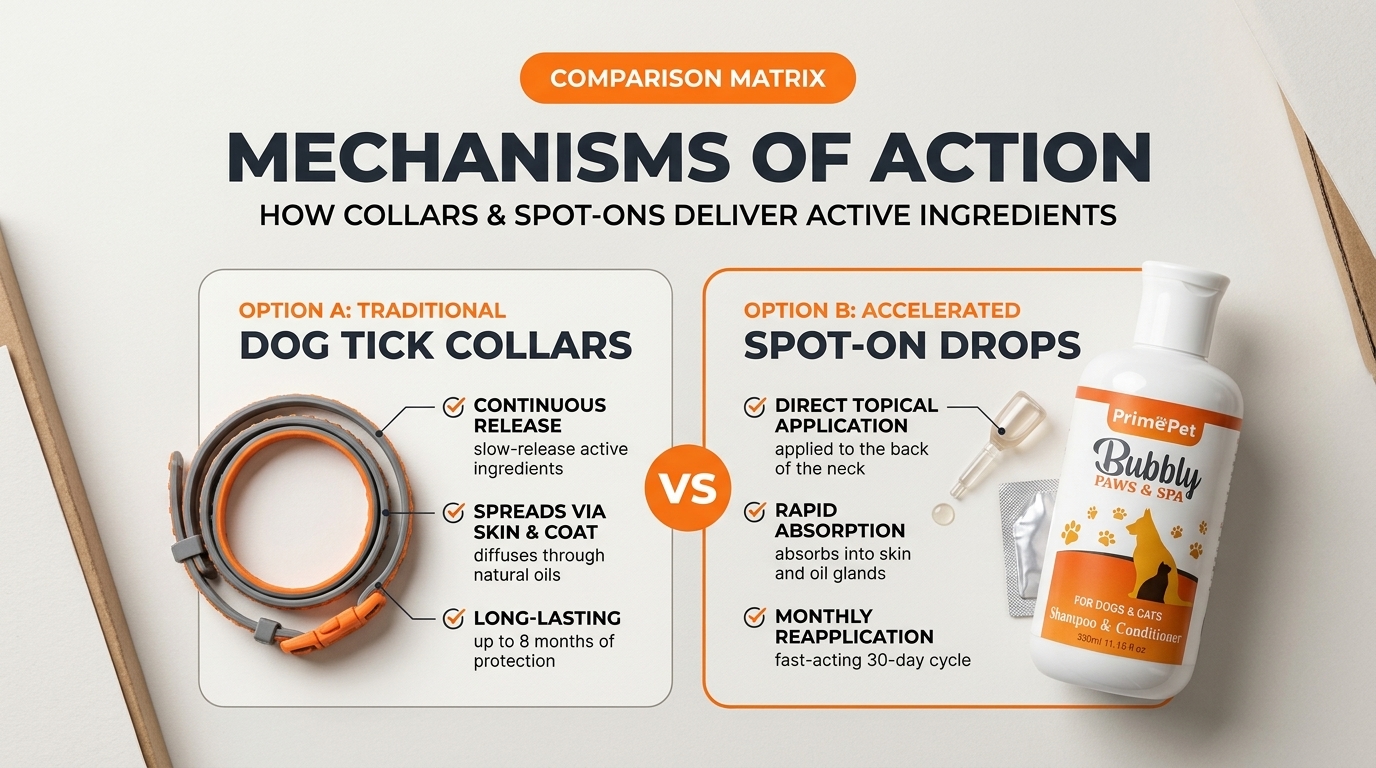
When you part your dog's fur to snap on a collar or squeeze out a liquid pipette, you aren't just applying medicine to one spot. You're triggering a complex physical distribution process. Understanding the mechanics of a dog tick collar vs spot on treatment reveals why these two formats behave so differently once they touch your pet's fur.
Both methods rely on the dog's skin, but they travel along completely different biological pathways to build a protective shield.
Collar Matrix Systems and the Sebum Highway
Modern tick collars don't work like the old powdery flea bands from decades ago. Today's high-grade collars use a dense polymer matrix. Think of this matrix like an engineered sponge packed with active ingredients such as flumethrin or imidacloprid. The chemicals stay locked inside the plastic until the collar rests against your pet's neck.
Body heat and constant friction trigger the release. As your dog moves, microscopic doses of the active ingredients leach out of the band. These molecules are lipophilic, meaning they dissolve readily in fats and natural oils. They dissolve straight into your dog's thin surface lipid layer—the oily coating covering their skin. From there, normal body movement and natural lipid dispersion spread the compound from the neck down to the tips of the paws and tail.
This process takes time. It operates like a steady drip irrigation system. It usually takes 48 hours to a full week for the active molecules to coat the entire body surface. Once established, the collar maintains a continuous, low-dose equilibrium across the coat for months at a time.
Field Practitioner Note: The collar must have direct contact with your dog's skin to activate this lipid migration. If the band hangs too loose over a dense undercoat, friction drops, the oils never pick up the actives, and tick defense fails around the hindquarters.
Spot-On Diffusion: Reservoir Dynamics in the Skin
Topical drops handle the job with an immediate burst rather than a months-long trickle. When comparing a dog tick collar vs spot on pipette, the primary difference lies in how the chemical creates its storage reservoir on the dog's body.
A spot-on dose delivers a concentrated dose suspended in an organic solvent. You apply this liquid directly between the shoulder blades. Capillary action pulls the fluid across the skin surface within hours. Yet, the real engineering happens just below the visible surface in the sebaceous glands.
| Delivery Metric | Polymer Matrix Collar | Monthly Topical Spot-On |
|---|---|---|
| Primary Pathway | Surface lipid layer migration | Sebaceous gland reservoir & transdermal uptake |
| Full Coverage Speed | 48 hours to 7 days | 12 to 24 hours |
| Release Profile | Constant, low-concentration steady state | High initial peak, slowly declining over 30 days |
| Storage Site | Internal matrix inside the collar plastic | Sebaceous glands and hair follicles |
The sebaceous glands act as microscopic natural pouches at the root of every hair follicle. Actives like fipronil soak deep into these glands. Over the next 30 days, as the glands produce fresh natural sebum to lubricate the skin, they steadily secrete the parasiticide back up the hair shaft. Other spot-on formulations work transdermally, crossing the dermal barrier directly into the bloodstream to target biting pests from within, a process detailed in veterinary research on dermal parasiticide distribution.
The Hidden Factor: Your Dog's Skin Barrier Health
Here is what many owners overlook: both delivery models completely collapse without healthy skin oils. If your dog has dry, cracked skin, coarse fur, or suffers from frequent soapy baths that strip away natural lipids, neither the collar nor the spot-on will distribute properly. The chemicals get trapped near the application site, leaving the legs, belly, and tail exposed to hungry ticks.
A balanced skin barrier requires steady nutritional support from within. Many commercial dry kibbles lose sensitive fatty acids and micronutrients during high-heat cooking. Adding PrimePet Vital Mix Multivitamin & Mineral Supplement for Dogs & Cats (available at its standard direct price of PKR 1,500) gives your pet the essential minerals, vitamins, and cellular fuel needed to maintain a vibrant dermal barrier. Healthy sebaceous glands produce the rich lipid matrix required to keep external tick treatments working at peak performance, ensuring your dog stays protected from nose to tail.
Dog Tick Collar vs Spot On: Speed of Kill and Repellent Power Compared
Comparing Kill Speed: Dog Tick Collar vs Spot On Solutions
When an engorged parasite burrows into your dog's skin, seconds count. The biological race starts immediately because dangerous pathogens, including Lyme disease and anaplasmosis, usually take 24 to 48 hours of attachment to transmit into the bloodstream. Evaluating a dog tick collar vs spot on treatment comes down to how fast each vehicle delivers active chemicals to the parasite's nervous system.
Spot-on drops act like a quick chemical bath for the skin. Once you part the fur and squeeze the liquid onto the base of the neck, the active ingredients dissolve into your pet's natural sebum layer. Most modern spot-on drops, such as those combining fipronil or permethrin, achieve peak parasite kill rates within 24 to 48 hours after application. If your dog already has active, feeding ticks, topical spot-on treatments quickly fix the infestation by paralyzing the tick's nerve pathways upon direct contact.
Tick collars work on a slow-release principle. Instead of dumping a monthly payload all at once, collars infused with flumethrin or deltamethrin steadily release microscopic doses across the dog's coat over weeks and months. If you snap a fresh collar on an infested dog, it can take 48 hours to build sufficient surface concentration to kill existing ticks. Once the collar achieves a steady state across the skin, it matches topicals by killing newly arriving ticks within 24 to 48 hours.
Field Observation: A tick crawling on your dog does not mean the preventative failed. Both collars and topicals require the parasite to contact the treated hair or skin before toxicity sets in. Death is rarely instant; it typically takes several hours of neurotoxic shock for the tick to release its grip and curl up.
The Anti-Feeding Factor: Do They Repel or Just Kill?
Killing a tick after it bites is helpful, but preventing the bite altogether is the gold standard. This barrier defense is known as the "anti-feeding effect" or repellency. It occurs when a chemical irritates the parasite's sensory organs, creating a hot-foot reaction that forces the tick to drop off before embedding its mouthparts.
| Treatment Type | Primary Repellent Mode | Average Kill Speed | True Anti-Feeding Power |
|---|---|---|---|
| Pyrethroid-Based Collar (e.g., Flumethrin) | Continuous slow-release barrier through lipid matrix | 24 to 48 hours (after initial 48h load) | High; causes sensory disruption and forces tick drop-off before biting. |
| Combination Spot-On (e.g., Permethrin + Dinotefuran) | High-potency skin surface absorption | 12 to 24 hours post-absorption | Very High; delivers rapid knockdown and prevents attachment. |
| Fipronil-Only Spot-On | Absorption in sebaceous glands | 24 to 48 hours | Low; relies on direct contact or biting rather than airborne or tactile repellency. |
Many dog owners are surprised to learn that not all spot-on drops repel. Formulations relying strictly on fipronil kill ticks efficiently, but only after the parasite crawls across the skin or attempts to feed. If you live in an endemic area dense with brush and deer ticks, you want true repellency. Spot-ons containing permethrin or collars formulated with flumethrin cause tick sensory ataxia—making the tick feel like it stepped on a hot stove burner—so it falls away harmlessly into the leaf litter.
Water Exposure, Frequent Grooming, and Outdoor Durability
How does real life affect chemical potency? Dogs swim, dig in mud, and get shampooed. Both formats face distinct vulnerabilities when exposed to heavy water and rough outdoor lifestyles.
Topical drops bond directly to the lipid layer of your dog's skin. You must keep your dog dry for 48 hours after application so the liquid can fully distribute across the body. After that curing window, moderate swimming in freshwater won't strip the treatment. Frequent washing with soap-based shampoos, however, will strip the natural oils and wash away the protective shield. If your pet gets bathed every weekend, a monthly spot-on can lose its killing power by week three, leaving a dangerous protection gap.
Collars handle water differently. Premium polymer collars hold their active ingredients trapped inside a solid matrix, releasing them slowly over time. If your dog dives into a lake, the chemical on the outer coat rinses away, but the collar immediately begins replenishing the lipid barrier. While collars are water-resistant, regular swimming or monthly medicated baths will deplete the reservoir faster. An 8-month collar on an active retriever that swims twice a week might run dry by month five or six.
Tick bites drain cellular vitality and challenge your dog's natural defenses, even when your parasite prevention works as planned. If your companion dog is recovering from tick bites, heavy parasite exposure, or the physical stress of outdoor adventures, targeted nutrition helps restore normal balance. PrimePet Vital Mix Multivitamin & Mineral Supplement for Dogs & Cats (Primepet Vital), available directly for PKR 1,500, delivers bioavailable micronutrients that reinforce cellular immunity and healthy tissue repair. Because standard commercial kibble often loses vital heat-sensitive nutrients during manufacturing, adding this comprehensive daily powder helps your pet rebuild red blood cells and maintain peak stamina throughout high tick season.
Answering Common Real-World Concerns
Why do I still see live ticks on my treated dog?
Parasites must pick up a lethal dose by crawling over treated hairs. During this time, they remain mobile. If you hike through tall brush, ticks will hitch a ride on the outer coat. If your preventative is working, those ticks will appear disoriented, unattached, or shriveled within a few hours.
Which format delivers the fastest immediate fix for sudden infestations?
When managing a high-load emergency where dozens of ticks are already attached, a fast-acting combination spot-on provides a quicker knockdown than a collar. The concentrated liquid floods the skin within hours, while a newly attached collar requires up to two full days to distribute protective compounds from the neck down to the hind legs and tail.
Choosing between a dog tick collar vs spot on treatment requires balancing how fast you need active pests eradicated against your dog's swimming habits and your willingness to maintain strict monthly dosing calendars.
Safety Profiles: Multi-Pet Households, Children, and Adverse Reactions
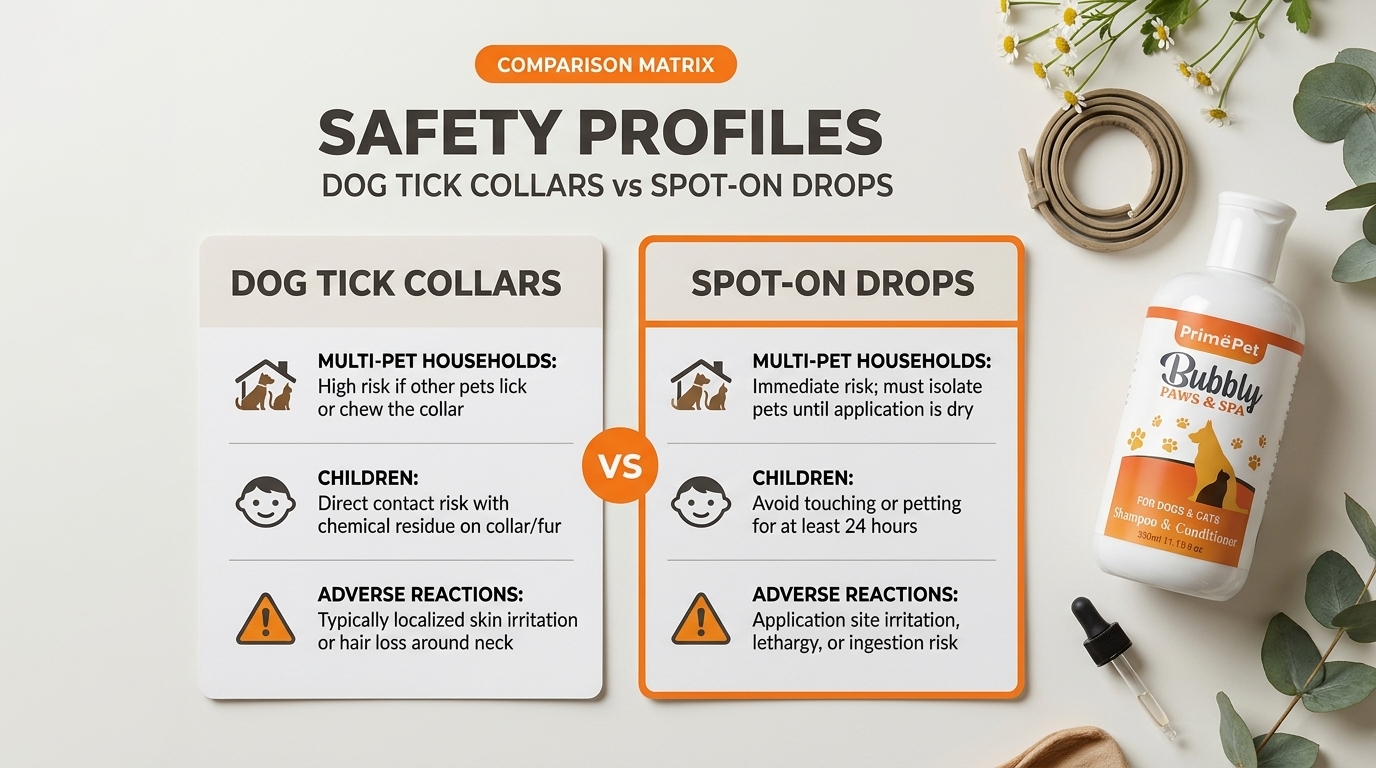
Household safety often breaks the tie when deciding between collars and topical applications. While both methods clear away blood-feeding pests, the chemical footprint they leave on your dog's coat affects everyone sharing your living room. Children hug pets closely, puppies play-bite necks, and cats groom their canine companions. When weighing a dog tick collar vs spot on treatment, household composition matters far more than retail convenience.
Dog Tick Collar vs Spot On: Navigating Toxicity Risks Around Cats
Cats are not small dogs. Their livers lack a vital detoxifying enzyme called glucuronosyltransferase. Because of this genetic absence, felines cannot break down permethrin, a potent synthetic pyrethroid found in many top-rated canine spot-on treatments. If a cat licks wet permethrin from a dog's shoulder blades or snuggles against recently treated fur, disaster follows quickly.
Permethrin poisoning triggers violent muscle tremors, dilated pupils, hypothermia, and life-threatening seizures within hours. Veterinary emergency rooms treat hundreds of these accidental exposures every year. Collars like Seresto rely on imidacloprid and flumethrin instead of permethrin, making them significantly safer for feline housemates. Even so, cats should never chew on a dog's collar during play.
Clinical Rule of Thumb: If your dog and cat sleep curled together or groom each other daily, avoid permethrin-based topical drops entirely. Choose a feline-safe topical formulation or an active polymer collar.
Direct Physical Risks: Chemical Burns vs. Swallowed Collars
Adverse reactions come in two distinct flavors: surface skin irritation and accidental poisoning from chewing.
| Risk Factor | Spot-On Topical Treatments | Slow-Release Tick Collars |
|---|---|---|
| Skin Reactions | Solvents can cause contact dermatitis, redness, localized hair thinning, and intense itching at the application spot. | Mechanical rubbing or chemical sensitivity can cause neck chafing, flaky skin, or patchy hair loss under the band. |
| Ingestion Hazard | Low after drying. If licked while wet, expect bitter drooling, mouth foaming, and mild stomach upset. | High in multi-dog play. Swallowing a severed collar can cause intestinal blockage and intense neurological distress. |
| Reversibility | Hard to reverse quickly once the oily carrier absorbs into sebaceous glands; requires repeated degreasing dish soap baths. | Instant. Unbuckle the collar and remove it immediately if your dog displays unusual lethargy or scratching. |
Do you have two rowdy young dogs who spend hours wrestling in the yard? Collars pose a distinct physical danger in those homes. Dogs frequently mouth each other around the scruff. If one dog manages to pry off and swallow the other's collar, the plastic matrix acts as a sustained-release pill inside the stomach. That scenario requires emergency veterinary surgery.
Protecting Children from Parasiticide Residue
Toddlers explore the world through their hands and mouths. They pet the family retriever, grab its collar, and then shove their fingers straight into their mouths. Keeping kids safe requires a realistic look at how these chemical delivery vehicles work.
Spot-on vials flood your pet's skin with a concentrated liquid solvent. The coat remains wet and tacky for up to 48 hours. During this initial dry-down window, kids must not hug the dog, groom the dog's coat, or let the dog sleep in their bed. Once that 48-hour period passes, the oily base spreads across the skin layer, dropping transdermal transfer to negligible levels.
Tick collars present the opposite dynamic. There is no wet downtime, but the collar maintains an active chemical coating for up to eight straight months. Teach children never to grip or tug the collar band directly. Make regular handwashing a standard house rule after heavy cuddle sessions. For concerned parents who want to review chemical reporting, the EPA pet safety guidelines provide clear baseline warnings on pesticide exposure around infants.
Rebuilding Skin Defenses After Chemical Reactions
Parasite control puts stress on your dog's largest organ: the skin. Whether your pet experiences minor localized flaking from an active collar or greasy redness from a monthly drop, harsh chemical barriers can deplete natural epidermal lipids. When the skin barrier cracks, secondary yeast and bacterial infections often follow tick bites and chemical reactions.
Standard commercial kibbles lose critical heat-sensitive vitamins during manufacturing, leaving pets ill-equipped to repair irritated skin tissue. Adding PrimePet Vital Mix Multivitamin & Mineral Supplement for Dogs & Cats directly to daily meals helps bridge that nutritional deficit. Formulated for everyday wellness at an authentic direct rate of PKR 1,500, this powder delivers balanced micronutrients, trace minerals, and essential vitamins that reinforce cellular immunity and accelerate skin healing after parasite-related irritation.
Watch your dog closely for the first 72 hours after applying any pest treatment. If you notice persistent redness, tremors, excessive drooling, or sudden lethargy, rinse the pet thoroughly with mild dishwashing soap, remove all wearable bands, and reach out to your veterinarian right away.
Longevity and Value: Evaluating 8-Month Wear Against Monthly Dosing
Parasite prevention comes down to a balance between biology and your personal routine. Long-acting collars offer a "set-it-and-forget-it" fix. You buckle the band around your dog's neck, trim the excess, and enjoy eight full months of continuous protection. Monthly spot-on pipettes, by comparison, demand strict calendar alerts. Miss a dose by just a week, and your dog faces an unprotected gap where ticks can latch on. Many dog owners still prefer spot-ons because they dislike paying a steep price upfront for a collar that could snag, get chewed, or slip off during rough play.
The Economics of Dog Tick Collar vs Spot On Treatments
The financial debate between a dog tick collar vs spot on application centers on immediate costs versus long-term value. Leading eight-month collars, such as the Seresto collar, typically retail between $60 and $80. While that number feels hefty at the register, it breaks down to roughly $8 to $10 per month of active defense. Premium monthly topical spot-on options, such as K9 Advantix II or Frontline Plus, usually cost between $15 and $22 per single-dose pipette, or roughly $55 for a three-month pack. If you need uninterrupted, year-round defense, the collar provides a noticeably lower daily cost.
| Evaluation Factor | 8-Month Wear Collar (e.g., Seresto) | Monthly Spot-On Pipette (e.g., K9 Advantix II) |
|---|---|---|
| Upfront Price | Higher initial outlay ($60 - $80) | Lower entry barrier ($15 - $22 per dose) |
| Dosing Cadence | Once every 240 days | Every 30 days without fail |
| User Compliance Risk | Near zero once securely fastened | High; forgotten doses leave gaps in defense |
| Seasonal Flexibility | Rigid; wears out whether ticks are active or not | Flexible; easily paused during freezing winters |
| Water & Bathing Impact | Frequent swimming can cut life to 5 months | Can wash away if applied right before swimming |
Real-world conditions can alter these numbers. In active dog communities, pet owners often report that water-loving breeds cut down collar longevity. If your retriever swims in lakes every weekend or gets frequent medicated baths, active ingredients wash away faster from the skin surface. The collar must replenish that protective lipid layer more often, which can shrink an eight-month collar down to five months of true potency. That early expiration raises your effective monthly cost. Spot-on pipettes shine for families living in cold northern climates where ticks vanish for six months of the year. Buying three topical doses for the summer is far more economical than paying for an eight-month collar that sits idle all winter.
External pest tools defend against surface bites, but parasites still place severe physical stress on your dog before the chemicals kill them. Fleas and ticks draw blood, cause allergic flare-ups, and trigger systemic immune reactions. Standard commercial pet kibble frequently loses vital minerals and heat-sensitive vitamins during factory processing, leaving dogs with nutritional gaps right when their systems need repair. Adding PrimePet Vital Mix Multivitamin & Mineral Supplement for Dogs & Cats to their daily bowl offers an authentic, high-quality solution for PKR 1,500. This targeted multivitamin and mineral blend delivers key micronutrients that rebuild cellular defenses, revitalize energy, and help restore coat health after parasite exposure.
Your ultimate decision comes down to lifestyle and discipline. If you know you will forget a monthly calendar reminder, a long-wear collar eliminates human error and saves money over an entire season. If you prefer low upfront commitments, have a heavy swimmer, or only battle ticks for ten weeks each summer, monthly spot-on tubes offer the practical control you need.
Which Option Fits Your Dog? A Decision Matrix for Everyday Lifestyles
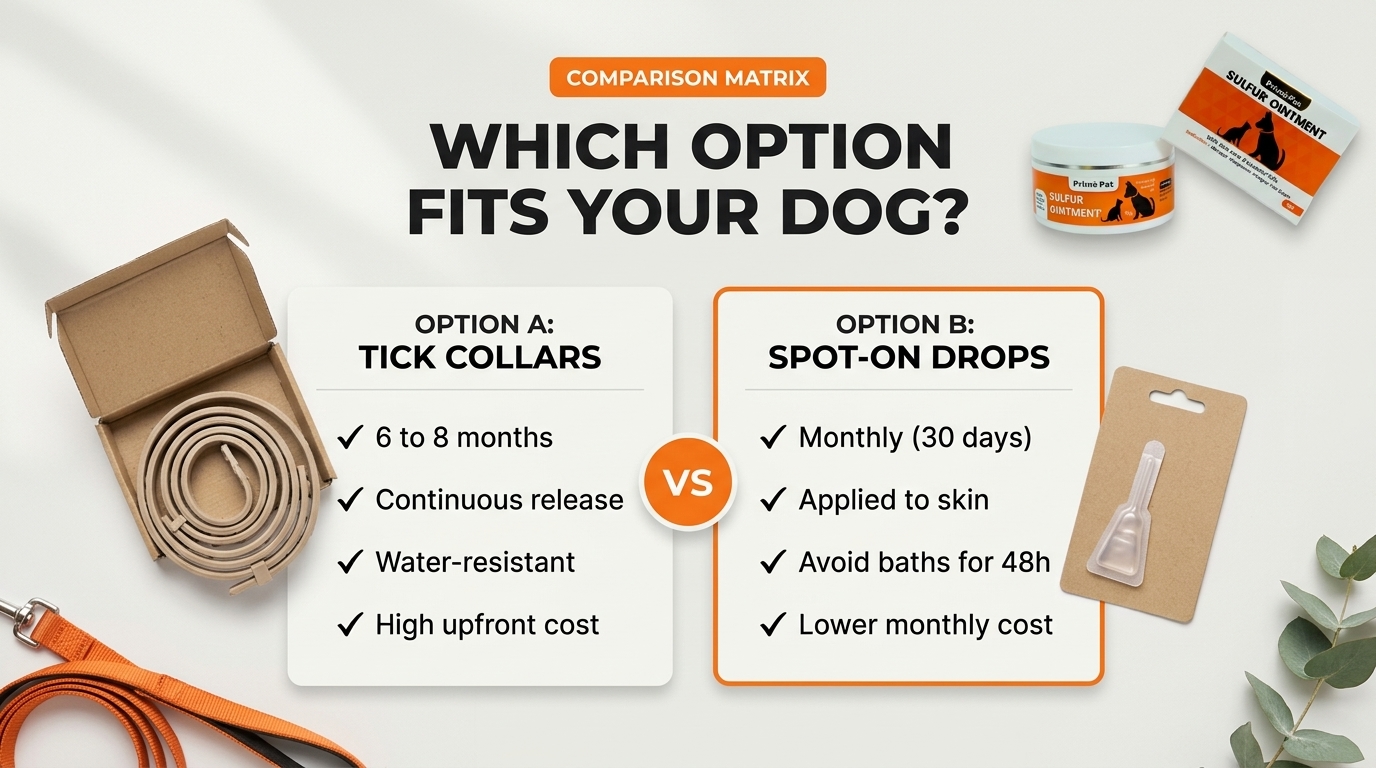
Choosing parasite protection is never a one-size-fits-all formula. The debate over a dog tick collar vs spot on drops comes down to your dog's daily habits, coat density, and your personal routine. Both formats offer a dependable fix against external parasites, but they fail when matched with the wrong lifestyle. A water-obsessed Labrador can wash away certain topicals before they bind. A thick-coated sheepdog can render a collar ineffective simply by blocking direct contact with the skin. Selecting the right option means looking past marketing promises and analyzing how your dog lives.
Dog Tick Collar vs Spot On: Evaluating Coat, Habitat, and Daily Routine
Every dog presents a unique combination of physical traits and environmental risks. Review this lifestyle matrix to determine which application method aligns with your pet's routine:
| Lifestyle Parameter | Better Fit: Tick Collar | Better Fit: Spot-On Drops | Practical Considerations |
|---|---|---|---|
| Coat Type & Length | Short, sleek coats (Boxers, Pointers, Great Danes) | Dense, double coats (Huskies, Golden Retrievers, Collies) | Collars require friction against bare skin to transfer active oils. Dense fur lifts the band away from the epidermis. |
| Swimming & Bathing Frequency | Occasional waders, dry-land trail runners | Frequent swimmers, dock-divers, dogs bathed bi-weekly | Topicals store inside the sebaceous gland system. Water cannot wash them out once they dry for 48 hours. |
| Multi-Pet Play Dynamics | Solitary dogs or calm, mature canine pairs | Dogs that wrestle, mouth necks, and groom each other | Rough play leads to chewed collars, leading to accidental pesticide ingestion and destroyed hardware. |
| Human Interaction | Households with older children or adults only | Homes with toddlers who constantly hug and pet dogs | Spot-ons absorb fully within 24 hours. Collars leave continuous trace residue on the outer plastic surface. |
| Owner Schedule & Memory | Busy owners who prefer a single seasonal fix | Diligent owners who track strict calendar reminders | A spot-on fails immediately if you miss a monthly dose by two weeks. Collars protect continuously for months. |
Water changes the math entirely. If your dog swims several times a week, topical spot-on drops perform far better than chemical collars. Even premium water-resistant bands release their reservoir slowly; repeated submersion depletes active ingredient concentrations on the coat faster than the plastic can replenish them. That easily cuts an eight-month lifespan down to four or five. In contrast, spot-on liquids move deep into the skin's oil glands within a day or two. Surface water does not rinse the active compound away once it bonds.
Fur density is another deciding factor. Collars work through sustained micro-friction against the neck, spreading repellent through the dog's natural sebum. If a thick, woolly undercoat prevents the plastic from touching bare skin, the chemicals stay trapped on outer guard hairs. Topicals bypass this problem. A narrow applicator pipette parts heavy fur, dispensing liquid directly onto bare skin for rapid systemic or epidermal spread.
External parasite defense only solves half of the wellness puzzle. Flea bites and tick attachments trigger acute inflammation, drain red blood cells, and introduce microscopic pathogens into the bloodstream. Reinforce your dog's natural vitality from within by adding PrimePet Vital Mix Multivitamin & Mineral Supplement for Dogs & Cats (Primepet Vital) to their daily bowl. Available at an accessible price of PKR 1,500, this complete daily powder delivers essential trace minerals, bioavailable vitamins, and antioxidants that standard kibble loses during high-heat cooking. Strong cellular immunity helps tissue heal faster if an opportunistic pest manages to latch on between preventive cycles.
Household dynamics matter just as much as outside terrain. Puppies and high-energy dogs that engage in mouthy play can puncture collar plastic or tear bands clean off during backyard romps. Ingesting collar fragments causes emergency veterinary visits and acute toxicosis. For multi-dog homes where dogs groom each other's necks, monthly spot-on applications offer a safer path. You only need to separate the pets for 24 hours while the application spot dries completely.
"My dog developed severe contact dermatitis after four weeks of wearing a plastic repellent collar. A red, hairless ring formed under his chin. We switched to monthly drops, and the irritation vanished within ten days."
Watch for individual skin sensitivities. Dogs with history of contact allergies or sensitive skin rarely tolerate a sustained chemical band resting against their neck 24 hours a day. For those animals, a quick monthly topical liquid prevents chronic chafing while delivering equivalent parasite knockdown power. Evaluate your dog's physical build, swimming routine, and play style honestly before picking your preventive fix.
Supporting Cellular Immunity and Post-Parasite Recovery with PrimePet Vital Mix
Tick bites steal far more than just a drop of blood. When a tick latches on, it injects foreign saliva loaded with anticoagulants directly into your dog's bloodstream. That single bite kicks off an internal alarm, forcing the immune system into overdrive to manage local inflammation and neutralize potential blood-borne pathogens. Layering on preventative chemicals puts another quiet demand on your dog's system as their liver and skin process the active agents.
Beyond the Dog Tick Collar vs Spot On Choice: Restoring Your Pet's Internal Shield
Whether you land on a dog tick collar vs spot on treatment, topical drops and medicated bands only handle the perimeter defense. They kill or repel parasites on the surface, but they don't repair the cellular wear and tear left behind. Commercial dog foods rarely provide the therapeutic backup required for rapid healing. Standard kibbles often lose heat-sensitive vitamins and critical trace minerals during high-temperature extrusion, leaving your dog running on nutritional empty during a recovery phase.
External preventives stop the next bite. Targeted daily nutrition repairs the damage caused by the last one.
Closing that nutritional gap is the exact role of PrimePet Vital Mix Multivitamin & Mineral Supplement for Dogs & Cats. Available for PKR 1,500, this balanced daily powder functions as an accessible nutritional bridge. It restores the bioavailable micronutrients cooked out of standard feeds, delivering the zinc, B-complex vitamins, and natural antioxidants needed to speed up tissue regeneration, reinforce cellular immunity, and bring back natural energy levels.
Common Recovery Questions Answered
Is an internal supplement worth the PKR 1,500 investment if my dog already uses preventives?
Yes. Pet owners often ask in pet health community discussions whether supplements are truly needed alongside parasite treatments. Think of external pest control like a home security alarm, while internal supplementation is the maintenance crew. Collars and spot-on drops stop invaders at the door, but PrimePet Vital Mix supplies the raw materials your pet needs to rebuild cellular membranes, clear out systemic toxins, and fix dull, irritated skin coats.
How does micronutrient support strengthen the dermal barrier?
A dog's skin is their primary physical barrier against the world. Frequent scratching from flea bites or localized swelling around tick sites breaks down this outer shield, inviting secondary bacterial infections. The bioavailable vitamins in PrimePet Vital Mix promote healthy lipid production in the epidermis. That keeps the skin supple, halts excessive flaking, and ensures topical spot-ons spread evenly across a healthy, resilient lipid layer.
Integrating PrimePet Vital Mix into your dog's regular meal routine guarantees their immune defenses don't falter between monthly preventive doses. While you manage the external pests, their body stays energized, strong, and ready to bounce back from any seasonal challenge.
Creating a Comprehensive Year-Round Defense Plan for Your Dog
Balancing Dog Tick Collar vs Spot On Treatments with Whole-Body Defense
Choosing between a dog tick collar vs spot on drop boils down to lifestyle, household dynamics, and your personal routine. Neither option offers an absolute fix if used in isolation. Monthly spot-on drops work exceptionally well for dogs that swim often or engage in rough play where a collar might catch or pull loose. However, topicals demand strict calendar tracking. Missing a monthly dose by even a few days leaves a window of vulnerability that parasites readily exploit. Sustained-release tick collars solve that compliance headache by delivering steady protection for up to eight months. They give pet parents a reliable, low-maintenance shield, provided the collar maintains snug contact with the skin.
External parasite preventatives act like a perimeter fence around your dog. Spot-ons and collars spread their active chemicals across the skin through the natural sebum layer, the thin lipid coating produced by your dog's sebaceous glands. If your dog suffers from a dry, brittle coat or unbalanced dermal lipids, these chemical active ingredients struggle to distribute evenly across the body. Chemical shields also do not stop every single pathogen from challenging the immune system. Ticks carry microscopic blood parasites like Babesia and Ehrlichia. A single bite before the parasite dies can trigger an immune battle beneath the skin surface.
External treatments kill the invaders on the outside, but your dog's cellular vitality determines how quickly they bounce back from toxic bites, skin irritation, and systemic stress.
A resilient defense requires pairing outer protection with deep nutritional support. Most commercial kibble formulas undergo intense heat extrusion during production, destroying delicate vitamins and heat-sensitive trace minerals along the way. Reinforcing your pet's daily meals with PrimePet Vital Mix Multivitamin & Mineral Supplement for Dogs & Cats (Primepet Vital) #2 helps close these dietary gaps. Priced directly at PKR 1,500, this veterinarian-formulated blend delivers key micronutrients that nourish the lipid barrier of the skin, boost systemic immunity, and sustain cellular energy levels. That healthy dermal barrier allows topical spot-ons and collar actives to migrate effectively, while the immune support protects the body from within.
Review your dog's health profile with your family veterinarian at least once a year. Your vet can pinpoint local tick resistance patterns, monitor liver and kidney parameters, and confirm whether a topical drop or a medicated collar fits your dog's age and health status. Combine that clinical advice with daily physical tick checks around the ears, belly, and toes after every outdoor hike. When you back up reliable chemical defense with strong nutrition and routine veterinary care, you give your dog the foundation for a long, active, parasite-free life.
Dr. Attaur Rehman (DVM)
Certified Veterinary Surgeon and Founder of Prime Pet Pakistan. Lab-formulated treatments and authentic clinical care for dogs and cats.