Parvo Disinfectant vs Bleach: What Kills the Virus?
Few phone calls terrify a dog owner quite like a positive test for Canine Parvovirus (CPV). Once this microscopic killer enters your home or kennel, eradicating it feels like an uphill war against an invisible enemy. Pet parents quickly face a high-stakes standoff between parvo disinfectant vs bleach, desperate to figure out what kills the virus before a vulnerable puppy gets exposed. Parvo isn't an ordinary germ. It won't wipe away with pine oil or dish soap.
Most common household cleaners target enveloped viruses—pathogens wrapped in a fragile fatty layer that ruptures with a simple squirt of generic multi-surface spray. Parvovirus doesn't work that way. It's a non-enveloped, protein-shielded tank. Sub-zero winter freezes won't phase it, and as pet owners frequently share on Reddit canine health forums, parvo can happily survive boiling water and persist outdoors in soil for over a year. Everyday antibacterial wipes give owners a false sense of security while leaving virulent particles ready to infect the next puppy that walks across the floor.
That resilience creates a difficult choice. Should you rely on a cheap bottle of grocery store bleach, or should you invest in a specialized veterinary cleaner like Rescue Disinfectant? Bleach remains a traditional staple because it costs pennies. But it carries harsh penalties: noxious respiratory fumes, ruined fabrics, and rapid breakdown whenever it meets organic matter like feces or vomit. Veterinary-grade formulations clean and kill in a single step without choking out your pets, yet they demand a higher upfront budget. Comparing the practical realities of a specialized parvo disinfectant vs bleach helps you make the right call to protect your pack and clean your home safely.
Table of Contents
- Understanding the Science: How Parvovirus Resists Standard Household Cleaners
- Parvo Disinfectant vs Bleach: Contact Time, Dilution, and Killing Power
- The Organic Load Factor: Why Bleach Fails on Soiled Surfaces
- Toxicity, Fumes, and Surface Damage: Assessing the Hidden Risks of Bleach
- Veterinary-Grade Disinfectants: Efficacy and Practicality in Warm Climates
- Which Option Should You Choose for Active Outbreaks vs Routine Cleaning?
- How to Properly Decontaminate an Infected Home and Yard
- Creating a Safe Environment: Final Steps to Prevent Parvovirus Reinfection
Understanding the Science: How Parvovirus Resists Standard Household Cleaners
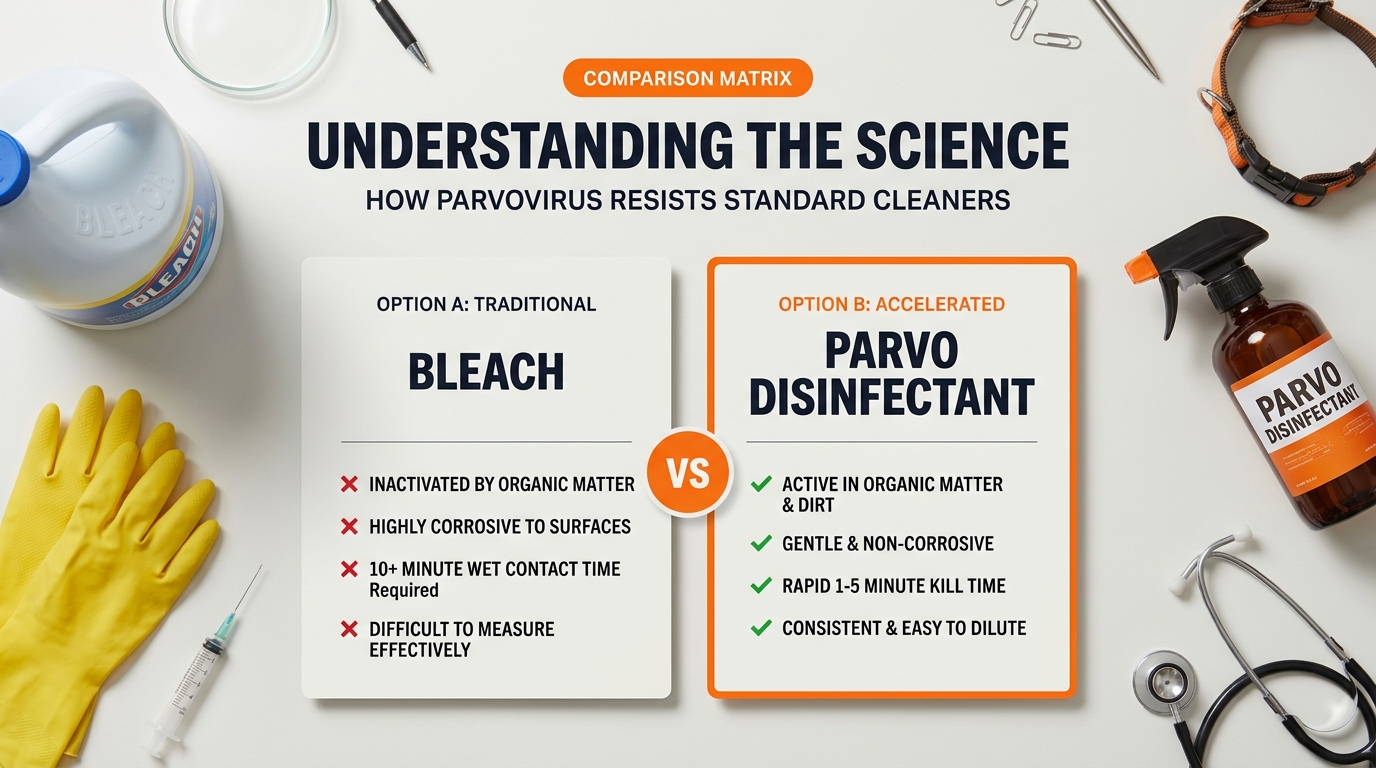
Canine parvovirus (CPV) isn't your average germ. Most pet parents assume that a quick mop with fragrant floor soap or a spray of household cleaner will sanitize their home. It won't. In fact, relying on standard supermarket cleaning sprays after an exposure leaves puppies at grave risk. Parvo laughs off the cleaners that easily kill human flu or common bacteria.
To understand why this happens, you have to look at how viruses are built. Many dangerous viruses—like influenza, canine distemper, and coronaviruses—are "enveloped." They wrap themselves in a fragile layer of fat taken from the host cell. Think of an enveloped virus like a soft water balloon wrapped in butter. If you hit that fatty layer with simple dish soap, rubbing alcohol, or pine oil, the grease dissolves. The balloon pops, and the virus falls apart instantly.
Parvovirus plays by completely different rules.
The Protein Armor: Why Parvo Disinfectant vs Bleach Debates Start at the Viral Shell
Canine parvovirus is a non-enveloped DNA virus. Instead of a delicate fatty envelope, it protects its genetic code with a tough, crystalline shell called a capsid. This capsid is made of tightly interlocking proteins. Picture a tiny golf ball carved out of hard plastic rather than a soft balloon of grease. Household cleaners designed to cut through fat have zero effect on it.
"The virus transmits via fecal material and organic matter deactivates most cleaners... standard cleaners just move it around." — Observed during community discussions with dog owners discussing parvovirus prevention on Reddit.
Because it lacks a lipid barrier, CPV can survive extreme environmental conditions that would wipe out other pathogens. It tolerates temperatures up to 140°F (60°C) for over an hour. It stays stable across a wild pH range from 3 to 9, meaning typical acidic or alkaline surface sprays won't dent it. Indoors, parvo can remain infectious on carpets, dog crates, and floorboards for months. In shaded outdoor yards and soil, active viral particles can easily linger for over a year.
Why Standard Household Cleaners Strike Out
Most everyday disinfectants fail against parvovirus because they rely on chemical mechanisms that cannot penetrate or denature a protein capsid:
- Pine oils and citrus cleaners: These rely on mild terpenes and surfactants. They lift surface dirt and smell nice, but they don't break protein bonds.
- Isopropyl and ethyl alcohol (70–90%): Alcohol dehydrates cells and shreds lipid membranes. It evaporates too quickly to damage parvo's capsid, leaving the virus completely unharmed.
- Over-the-counter quaternary ammonium sprays: Common antibacterial kitchen sprays use early-generation "quats." While great for everyday grime, the University of Wisconsin Shelter Medicine guide on parvo resistance confirms that these basic quats consistently fail against non-enveloped pathogens.
- Vinegar and baking soda: Acetic acid and sodium bicarbonate are completely powerless against parvo. Using them only creates a false sense of security.
| Cleaner Type | Mechanism of Action | Parvocidal Efficacy |
|---|---|---|
| Dish Soap & Detergents | Emulsifies fats; loosens surface debris | Fails (Rinses only, does not kill) |
| Rubbing Alcohol (70%) | Dissolves lipid membranes | Fails (Cannot penetrate capsid) |
| Standard Quats (Lysol sprays) | Disrupts cell walls of bacteria/enveloped viruses | Fails (Ineffective against CPV) |
| Oxidizing Chemistry (AHP / Bleach) | Denatures proteins; shatters DNA core | Effective (Destroys capsid) |
The Chemistry Required to Kill Parvo
You cannot kill this virus by suffocating it or washing it away with suds. You have to physically dismantle its protein shell using true oxidizing chemistry. When weighing a dedicated parvo disinfectant vs bleach, you are looking at compounds that split peptide bonds, unravel structural proteins, and blast through to the inner DNA.
Sodium hypochlorite (household bleach) does this by releasing hypochlorous acid, which strips electrons from the viral capsid and causes it to collapse. Veterinary alternatives, such as accelerated hydrogen peroxide (found in Rescue Disinfectant) or potassium peroxymonosulfate (like Trifectant), use engineered oxidation to rupture the capsid while avoiding harsh fumes. Without these specific chemical reactions, parvo remains active on your surfaces, waiting for the next unprotected puppy to walk by.
Parvo Disinfectant vs Bleach: Contact Time, Dilution, and Killing Power
Bleach has been the classic shelter weapon against pathogens for decades. It is cheap, accessible, and deadly to single-celled invaders. Modern veterinary science has introduced specialized chemical formulas that challenge chlorine's dominance. Deciding whether to grab a jug of supermarket bleach or invest in an EPA-registered veterinary sanitizer comes down to how these products behave under real-world conditions.
Comparing Parvo Disinfectant vs Bleach: Dilution, Dwell Time, and Stability
When weighing a dedicated parvo disinfectant vs bleach, the deciding factor rarely comes down to raw killing ability in a sterile lab. Both can destroy the non-enveloped capsid of canine parvovirus. The battle is won or lost in how strictly you can meet their operational demands.
| Performance Metric | Household Bleach (5.25–8.25%) | Accelerated Hydrogen Peroxide (Rescue) | Potassium Peroxymonosulfate (Virkon S) |
|---|---|---|---|
| Standard Parvocidal Dilution | 1:32 (approx. ½ cup per gallon) | 1:16 to 1:32 (concentrate) | 1% solution (tablets or powder) |
| Required Wet Contact Time | 10 continuous minutes | 5 to 10 minutes | 10 continuous minutes |
| Diluted Working Shelf Life | 12 to 24 hours maximum | Up to 90 days | 7 days (color-coded indicator) |
| Built-In Cleaning Surfactants | None (requires separate cleaning step) | Yes (cleans and disinfects in one step) | Yes (mild detergent action) |
| Surface Safety | Corrosive to metals; bleaches fabrics | Non-corrosive, fabric safe at working dilution | Mildly corrosive if left unrinsed on metal |
The Dwell Time Dilemma
Contact time—often called dwell time—is the total duration a chemical must stay visibly wet on a surface to kill a pathogen. If the chemical evaporates at minute seven, your disinfection attempt failed. Parvovirus will survive.
Bleach requires a strict 10-minute wet dwell time. In warm rooms or sunlit patios, a thin film of bleach solution evaporates in three to four minutes. You have to keep re-wetting the floor over and over to reach that 10-minute mark. Veterinary professionals frequently switch to accelerated hydrogen peroxide (AHP) products like Rescue Disinfectant because certain formulations achieve full virucidal kill in just five minutes. Cutting your required dwell time in half drastically reduces the chance that spots dry out too soon.
Pet owners often panic and mix dangerously strong concoctions. As seen in pet community decontamination threads, overwhelmed owners sometimes guess ratios as extreme as 3:1 water to bleach. Over-concentrating bleach creates toxic chlorine gases and ruins household surfaces without neutralizing the virus any faster than an accurate 1:32 mix.
Handling high-strength sanitizers around recovering pets requires careful toxicological awareness, as detailed in this clinical safety guide.
Dilution Degradation and Chemical Shelf Life
Bleach is chemically fragile. Sodium hypochlorite breaks down when exposed to ambient light, air, and heat. The moment you mix bleach with tap water in an ordinary spray bottle, an invisible countdown starts. Within 24 hours, that mixture degrades into basic salt water and loses its parvocidal strength.
"Diluting bleach creates an unstable solution. If you're spraying surfaces with yesterday's bleach bottle, you aren't disinfecting against parvovirus anymore—you're just damp-dusting."
Potassium peroxymonosulfate (found in compounds like Virkon S or Trifectant) relies on an active oxygen reaction. You drop a tablet or powder into water, and it turns bright pink. The pink shade acts as a visual safety timer. As long as the liquid stays pink—usually about seven days—the solution remains virucidal. Once the color fades to clear, discard it.
Accelerated hydrogen peroxide holds the crown for operational shelf life. A mixed batch of AHP concentrate diluted in clean water remains fully active for up to 90 days in a closed spray bottle. For veterinary clinics and foster homes that tackle frequent spot cleanings, avoiding daily mixing saves immense time while eliminating guesswork.
Never rely on splash-less, scented, or specialty color-safe bleaches. These formulas contain thickeners and perfume oils that lower the active hypochlorite percentage. Only standard, EPA-registered disinfecting bleach containing at least 5.25% to 8.25% sodium hypochlorite carries the oxidizing punch needed to shatter parvovirus capsids.
The Organic Load Factor: Why Bleach Fails on Soiled Surfaces
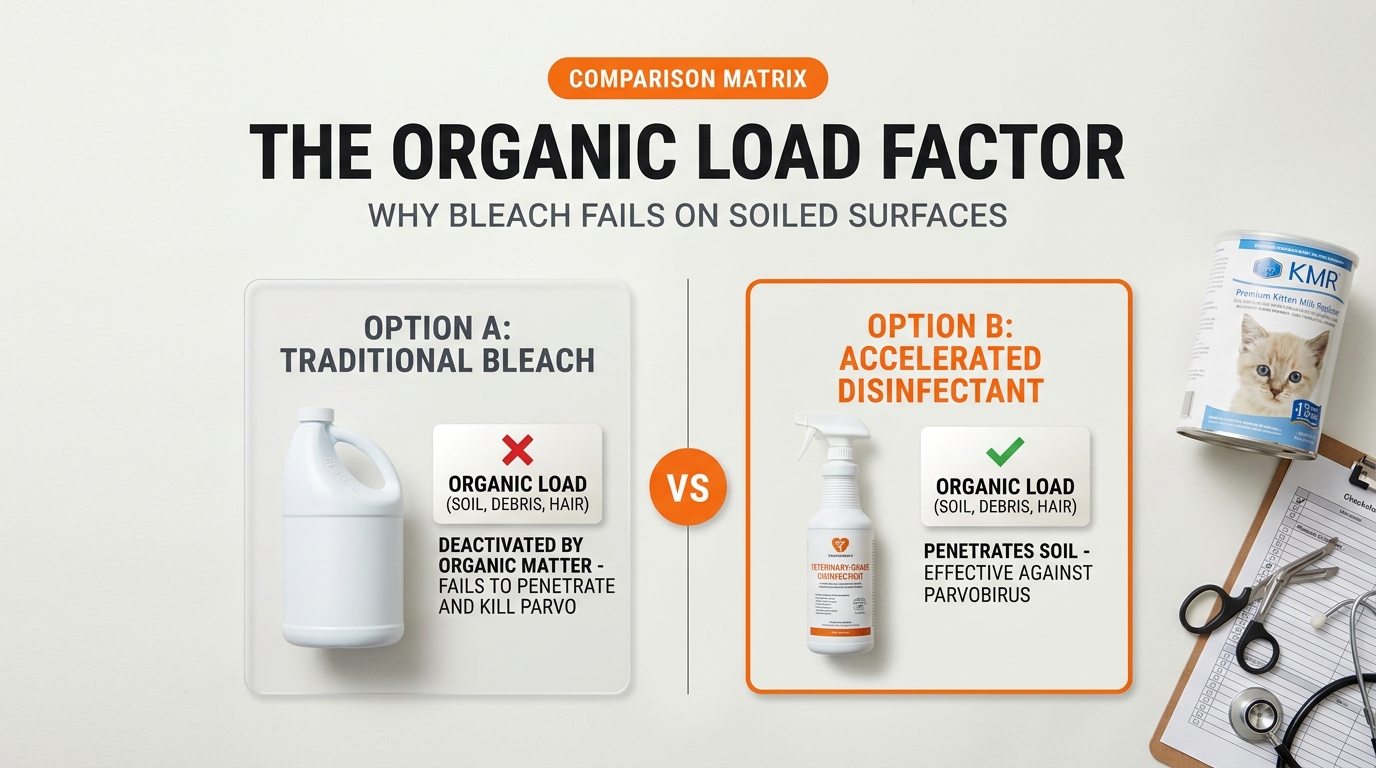
Picture this scenario: a puppy with suspected canine parvovirus vomits on the living room tile. You immediately reach for the gallon jug of household bleach, splash it across the floor, wipe it up, and assume the threat is gone. The pungent chlorine odor fills the room, convincing you that every last microbe has been wiped out.
You might be surprised to learn that the virus is likely still alive. Bleach has a fatal blind spot. It fails miserably the moment it runs into biological mess.
In veterinary medicine, this mess is called "organic load." It includes vomit, bloody diarrhea, saliva, skin cells, and simple backyard dirt. When dealing with an outbreak, understanding how these bodily fluids react with cleaning chemicals marks the difference between stopping a deadly virus and watching it spread to other pets.
Bleach is a strict sanitizer, not a cleaner. If you apply sodium hypochlorite directly to a soiled puddle, you aren't disinfecting the floor—you are merely neutralizing your bleach.
Evaluating Parvo Disinfectant vs Bleach Under Organic Load
Sodium hypochlorite—the active chemical in regular bleach—works through oxidation. It attacks chemical bonds and tears apart cellular structures. The problem? Bleach doesn't discriminate between a target viral capsid and a random speck of dietary protein from puppy stool. It attacks the very first biological matter it touches.
When bleach hits organic soil, a sacrificial reaction takes place. The active hypochlorous acid binds rapidly to the proteins and fats in the feces or vomit. Within seconds, the free available chlorine gets chewed up and converted into inactive salts and volatile chloramines. Those irritating fumes that sting your eyes don't mean the chemical is actively killing parvo. As pet owners often discover when troubleshooting bio-hazard sanitation, the sharp chlorine smell simply signals that the bleach is breaking down as it binds to surface gunk.
According to clinical University of Wisconsin-Madison shelter disinfection guidelines, every product in the bleach family is readily inactivated by organic material. If a microscopically thin film of grease, dried mucus, or dirt remains on the floor, the bleach cannot penetrate it. The parvo virions trapped beneath that crust stay perfectly infectious for months.
Discussions around home sanitation echo this reality. In a frank community debate on garment sanitation, one pet parent noted that most people have no clue how much organic soil ruins a chemical's true kill rate. That observation hits the nail on the head. A disinfectant can claim a 99.99% kill rate in a pristine laboratory petri dish, yet fail completely in a real-world home contaminated with canine bodily fluids.
This is where the debate over parvo disinfectant vs bleach turns in favor of modern veterinary formulas.
| Performance Factor | Household Bleach (5.25–6%) | Veterinary-Grade Disinfectant (AHP / Peroxygen) |
|---|---|---|
| Detergent / Surfactant Action | None. Bleach cannot cut through fats, oils, or biological grease. | Built-in surfactants lift debris and break through grease layers. |
| Organic Soil Tolerance | Extremely poor. Inactivates almost instantly upon touching protein. | High. Formulated to stay stable and lethal under moderate bio-loads. |
| Required Cleaning Steps | Strict two-step process: Deep-clean with soap first, rinse, then apply bleach. | Often a single-step cleaner-disinfectant for light-to-moderate messes. |
| Porous Surface Penetration | Fails on rough concrete, unsealed wood, or dirt runs. | Better surface-wetting properties help soak into micro-cracks. |
Specialized veterinary formulas take a totally different approach to bio-burden. Products based on Accelerated Hydrogen Peroxide (AHP), such as Rescue Disinfectant, combine an oxidizer with high-grade surfactants. The surfactants act like detergents. They dissolve fatty membranes and suspend fecal particles in the solution, allowing the hydrogen peroxide to bypass the grime and destroy the viral capsid directly.
Potassium peroxymonosulfate compounds like Virkon S function the same way. They buffer against acidity changes and chew through biological films without losing their oxidative punch. If a puppy leaves microscopic smears behind after you wipe up an accident, a veterinary disinfectant continues working. Bleach simply quits.
Can bleach kill parvovirus? Yes, absolutely—but only on an immaculate, non-porous surface that you've scrubbed clean with soap and water beforehand. In the real world, pet owners rarely have pristine surfaces during an active infection. That single difference is why veterinary clinics trust commercial disinfectants rather than standard supermarket bleach to stop disease transmission in its tracks.
Toxicity, Fumes, and Surface Damage: Assessing the Hidden Risks of Bleach
Safety Profiles: Parvo Disinfectant vs Bleach in Daily Use
Bleach packs a heavy punch against pathogens. It also takes a serious toll on the living creatures sharing that space. When you evaluate a dedicated parvo disinfectant vs bleach, killing the virus is only half the battle. You must protect the lungs, skin, and eyes of everyone inside the room. Bleach relies on sodium hypochlorite, a harsh chemical oxidizer that releases raw chlorine gas as it dries and reacts with organic matter.
In poorly ventilated homes, laundry rooms, or small isolation kennels, those fumes concentrate fast. Pet owners frequently report stinging eyes, burning sinuses, and dizziness within minutes of mopping. According to the CDC guidelines on chemical disinfectants, chlorine solutions release volatile compounds that irritate the respiratory tract. For an eight-week-old puppy battling parvovirus, this environment is hazardous. Parvo ravages the gut and suppresses the immune system, leaving animals vulnerable to secondary pneumonia. Forcing a sick puppy to breathe heavy chlorine gas inflames fragile airway tissues, triggering coughing fits and respiratory distress.
Field Note: Never mix household bleach with acids like vinegar or ammonia-based cleaners. This accidental combination generates toxic chloramine gas immediately, creating a medical emergency for both humans and pets.
Direct skin contact presents another hazard. Sodium hypochlorite is an alkaline substance that strips natural oils and breaks down cellular proteins. As detailed in clinical literature on caustic injuries from sodium hypochlorite, prolonged contact dissolves tissue surfaces rather than just irritating them. If a floor stays damp with a strong bleach mixture, dogs walking across the tile absorb it directly into their paw pads. Pads turn red, crack, and bleed. Because dogs instinctively lick their sore paws, they ingest the caustic residue, causing chemical burns on the tongue, painful mouth ulcers, and intense stomach upset.
| Hazard Factor | Standard Household Bleach | Modern Veterinary Disinfectant (e.g., AHP) |
|---|---|---|
| Vapor Toxicity | High; produces chlorine gas and harsh respiratory irritants. | Low to none; breaks down into simple water and oxygen. |
| Tissue Safety | Caustic; causes paw pad chemical burns and ulcerations. | Non-irritating at working dilutions once dried. |
| Surface Impact | Corrosive to metals, strips finishes, degrades tile grout. | Non-corrosive to stainless steel, sealed floors, and plastics. |
Bleach damages physical property just as easily. At the potent 1:32 dilution needed to deactivate canine parvovirus, bleach oxidizes raw metals rapidly. Wire crates, metal food bowls, and transport kennels quickly show signs of pitting and rust. The rust creates rough, microscopic pockets where organic debris gathers, making complete disinfection harder in the future.
Flooring doesn't hold up well either. Bleach strips the protective finish off sealed hardwood, dissolves linoleum adhesives, and eats away at cementitious tile grout. Over time, that degraded grout turns powdery and porous. The virus seeps deep into those cracks, out of reach of your cleaning mop. While bleach feels like a cheap fix from the grocery shelf, the long-term price of ruined equipment, damaged floors, and vet bills for burnt paw pads changes the math entirely.
Veterinary-Grade Disinfectants: Efficacy and Practicality in Warm Climates
Comparing Parvo Disinfectant vs Bleach: Veterinary Solutions for Warm Climates
Warm weather makes parvovirus cleanup significantly harder. Standard household bleach breaks down rapidly when exposed to heat and sunlight, losing its germ-killing hypochlorite ions before it can sanitize the ground. If you spray a hot patio on an 85-degree afternoon, the bleach mixture often evaporates in two or three minutes. That leaves the pathogen completely intact, because parvovirus requires at least ten full minutes of continuous wet contact time to die.
When evaluating a professional parvo disinfectant vs bleach under high temperatures, chemical stability becomes the deciding factor. Animal hospitals, shelters, and boarding facilities rarely rely on grocery-store bleach for large-scale decontamination. Instead, they depend on veterinary-grade chemistry engineered to survive heat, resist organic matter, and spare expensive surfaces from destruction.
Parvovirus is a non-enveloped virus. Think of it as a microscopic tank protected by a rigid protein shell. Without an outer lipid membrane to dissolve, weak cleaners bounce right off. The veterinary alternatives below actually penetrate that shell without the volatile breakdown seen in chlorine solutions.
The Big Three Veterinary Disinfectants
1. Accelerated Hydrogen Peroxide (Rescue / Accel)
Accelerated Hydrogen Peroxide, commonly known as AHP, blends low levels of hydrogen peroxide with specialized surfactants. This blend acts as both a potent cleaner and a hospital-grade disinfectant. Unlike bleach, which gets deactivated by dirt and pet hair, AHP cuts through microscopic organic layers to destroy the virus.
In hot environments, AHP holds up remarkably well. Concentrated jugs retain their potency for up to three years on the shelf, even in a warm utility closet. Once diluted in water, the working solution stays active for up to 90 days. AHP also carries a shorter required contact time—often just five minutes at a 1:16 dilution—meaning the liquid doesn't evaporate before it completes its job.
2. Potassium Peroxymonosulfate (Virkon S / Trifectant)
Virkon S is an oxidizing powder that mixes with water into a distinctive pink solution. It attacks the structural proteins of the virus through multiple chemical pathways. Because it ships and stores as a dry powder or compressed tablet, it offers superior heat stability during transport and storage in sweltering climates.
The dry powder lasts for years without losing strength. Once you dissolve it in water, the liquid remains fully effective for seven days. Virkon S features a built-in color indicator: when the pink color fades to clear, the solution has lost its sanitizing power. That simple visual cue prevents you from applying an expired chemical to an infected area.
3. Dual-Chain Quaternary Ammonium Compounds
Quaternary ammonium compounds (quats) are common in household antibacterial sprays. However, independent research published in the UW Madison Shelter Medicine protocol shows that older, standard quats fail to reliably kill canine parvovirus. The virus simply shrugs them off.
Modern dual-chain, fifth-generation quat formulations perform better than older blends, but most veterinary infection-control specialists still prefer oxidizing agents like AHP or Virkon S for active outbreaks. If you choose a quat product, check the label carefully. It must hold an explicit EPA registration stamp verifying efficacy against Canine Parvovirus.
| Disinfectant Type | Required Contact Time | Heat & Sun Stability | Mixed Shelf Life | Surface Compatibility |
|---|---|---|---|---|
| Bleach (Sodium Hypochlorite) | 10 minutes (wet) | Very Poor; breaks down in sunlight and heat | 24 hours | Corrodes metal; ruins fabric; kills grass |
| Accelerated Hydrogen Peroxide (Rescue) | 5 minutes | Excellent; resists moderate heat | 30 to 90 days | Safe on fabrics, stone, and unsealed floors |
| Virkon S (Peroxymonosulfate) | 10 minutes | High (powder form unaffected by heat) | 7 days | Mild to grass; safe on stone and concrete |
Surface Safety: Yards, Stone, and Outdoor Fabrics
Bleach damages outdoor living spaces. It strips the natural sealers off flagstone, bleaches patio cushions, and turns lawn grass into brown dead zones. The Veterinary Partner environmental decontamination guide notes that chlorine runoff can also leach deep into the soil where it harms beneficial garden microbes.
Accelerated hydrogen peroxide breaks down into basic water and oxygen after it kills pathogens. That makes it uniquely safe for outdoor fabrics, porous pavers, and kennel turf. You won't end up with bleach rings on your furniture or chemical residues that burn paw pads.
For large outdoor runs, gravel patches, and grass yards, Virkon S is the practical field standard. You can mix the powder in a garden pump sprayer, thoroughly saturate infected gravel or turf, and let it dry naturally. While no chemical completely sterilizes deep soil without harming plants, veterinary oxidizers reduce the environmental viral load far more safely than bleach ever could.
Which Option Should You Choose for Active Outbreaks vs Routine Cleaning?
Cleaning up after a healthy adult dog is entirely different from containing an aggressive viral pathogen. When you mop up muddy paw prints, almost any household cleaner gets the job done. But canine parvovirus is a non-enveloped virus, meaning it lacks a delicate fatty outer jacket. That tough protein shell makes it notoriously hard to destroy. Choosing between a standard bottle of household bleach and a specialized veterinary product isn't just a matter of price. It directly determines whether your home remains infectious for months or becomes safe for another pet.
Your choice depends on two factors: the presence of active viral shedding and the types of materials you need to treat. Here is how your options compare across real-world scenarios:
| Cleaning Scenario | Primary Recommendation | Why It Works Best |
|---|---|---|
| Routine Daily Maintenance (Fully vaccinated, healthy pets) |
Mild pet-safe surface cleaner or diluted multipurpose sanitizer | Zero respiratory irritation; gentle on floors, baseboards, and daily living spaces. |
| Emergency First-Response (Immediate post-diagnosis, late night) |
Diluted regular household bleach (1:31 ratio on clean surfaces) | Readily available at any grocery store; cheap and fast for non-porous crates and tiles. |
| Active Sick Room / Isolation (Dog vomiting, having diarrhea) |
Accelerated Hydrogen Peroxide (Rescue) | Works in the presence of organic debris, requires shorter contact time, and won't harm lungs. |
| Foster Setup / High Pet Turnover (Puppies and rescues coming through) |
Potassium peroxymonosulfate (Virkon S / Trifectant) | Broad-spectrum hospital-grade kill rate; stable formula for footbaths and equipment. |
| Post-Recovery Terminal Cleaning (Sanitizing before a new puppy enters) |
Veterinary disinfectant followed by steam cleaning | Penetrates porous materials where bleach fails; leaves no lingering toxic residues. |
Parvo Disinfectant vs Bleach: Choosing the Right Solution for Your Situation
Balancing the trade-offs of parvo disinfectant vs bleach comes down to your immediate environment, surface safety, and whether an active shedder is walking around. Bleach is an exceptional biocidal weapon, but it is notoriously finicky. If you apply diluted bleach to a floor that still has dried diarrhea or stomach fluids, the sodium hypochlorite reacts with the organic proteins instead of attacking the virus. The bleach deactivates before it can crack the viral shell.
According to UW Madison Shelter Medicine CPV guidelines, sodium hypochlorite requires an unsoiled surface and at least ten minutes of wet contact time to reliably eliminate parvo. If you use it, you must thoroughly wash the area with soap and water first, rinse away all soap residue (which can neutralize bleach), and only then saturate the surface with your bleach mix. That three-step process is tough to maintain during an overwhelming emergency.
If you reach for bleach in an emergency, make sure it is fresh. Regular household bleach degrades quickly once opened. Mix a fresh batch daily using cool water, as hot water breaks down chlorine gas and renders the solution useless within hours.
This is where specialized veterinary disinfectants demonstrate their true value. Products like Rescue (Accelerated Hydrogen Peroxide, or AHP) combine an effective germ killer with heavy-duty cleaning surfactants. They lift soil and kill the pathogen simultaneously. If a sick puppy has an accident, an AHP spray penetrates the bodily fluid, destroys the virus in four to five minutes, and breaks down into water and oxygen. You avoid the caustic fumes that burn puppy airways and ruin your furniture.
The video above walks through residential disinfection protocols for tough non-enveloped shelter viruses. It highlights how professional rescues strip infectious residues from living spaces without damaging home surfaces.
For routine house cleaning when all pets are healthy and up to date on vaccines, using heavy disinfectants is overkill. Normal dish soap and warm water handle common bacteria just fine. But if you foster puppies, run a boarding setup, or care for a dog recovering from an active infection, rely on specialized veterinary products. While you can keep bleach on hand for cheap crate drenching, expert guidance from Veterinary Partner environmental decontamination advice confirms that modern oxidative disinfectants provide far higher safety margins for homes where recovering pets sleep, eat, and breathe.
How to Properly Decontaminate an Infected Home and Yard
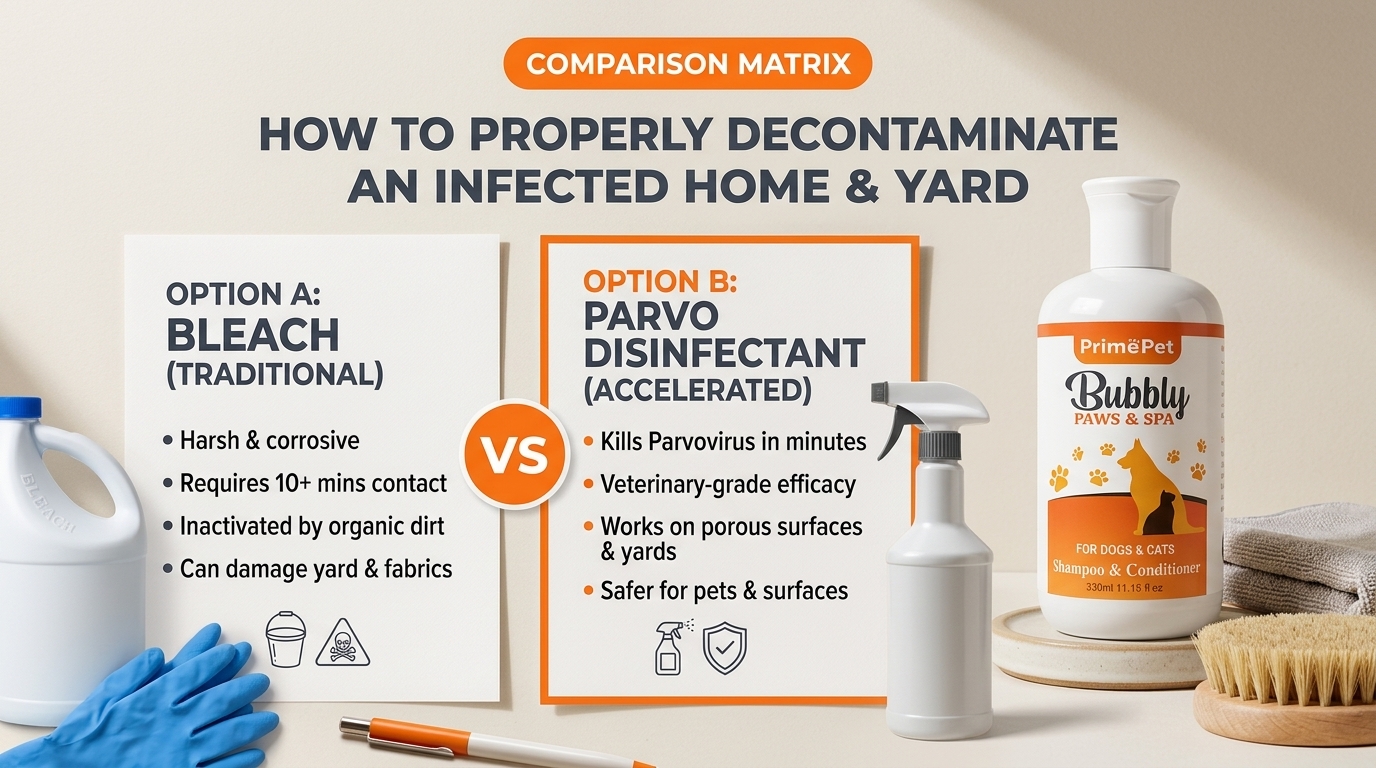
Parvovirus particles are shockingly tough. They have a non-enveloped protein shell that acts like a suit of armor, letting the virus survive on floors, carpets, and outdoor soil for months. If you try to clean up an accident with standard multi-surface spray, you will simply spread the viral particles across a wider area. Sanitizing your home after an exposure requires a strict, veterinary-approved sequence: remove, clean, and disinfect.
Step 1: Mechanical Pre-Cleaning
You cannot disinfect dirt. Disinfectants rely on direct contact with the viral shell to break it down. When viral particles sit buried under dried vomit, mucus, or fecal matter, that organic debris consumes the chemical before it ever reaches the virus.
Put on disposable gloves and eye protection. Pick up solid waste using disposable paper towels and seal it into a plastic trash bag immediately. Next, scrub the area with warm water and basic dish soap or an all-purpose detergent. This step doesn't kill the virus. Instead, it lifts grease and biological proteins off the floor. Rinse the area thoroughly with clean water to remove soap residue, which can neutralize certain disinfectants, and let it dry completely before moving to chemical treatment.
This instructional walkthrough from a verified creator details the exact mixing protocols and equipment needed to neutralize parvovirus on household surfaces.
Parvo Disinfectant vs Bleach: Indoor Dilution and Contact Times
When weighing a parvo disinfectant vs bleach for your indoor cleanup, you must balance raw killing power against chemical fumes and surface damage. Regular household bleach (sodium hypochlorite) works, but only when mixed fresh at the correct strength. Over-the-counter splashless bleaches or scented options do not contain the right concentration to kill parvovirus. Veterinary-grade accelerated hydrogen peroxide (AHP), such as Rescue Disinfectant, offers an alternative that breaks down into water and oxygen without degrading floor finishes.
| Product | Dilution Ratio | Wet Contact Time | Best Used On |
|---|---|---|---|
| Regular Household Bleach (5.25%–8.25%) | 1:31 (1/2 cup per gallon of cold water) | 10 full minutes | Sealed tile, stainless steel, plastic crates |
| Rescue (Accelerated Hydrogen Peroxide) | 1:16 (8 oz per gallon of water) | 5 minutes | Sealed hardwood, vinyl, rubber, exam tables |
| Virkon S (Potassium Peroxymonosulfate) | 1% solution (one tablet per pint) | 10 minutes | Concrete, outdoor kennels, transport vans |
Bleach solutions degrade rapidly when exposed to air and light. Mix a fresh batch in cold water right before use, as hot water breaks down sodium hypochlorite. Apply the liquid generously with a mop or spray bottle. The floor must stay glistening wet for the entire contact time. If the solution evaporates at the seven-minute mark, the virus may survive. Re-spray the area to keep it wet until the full timer rings, then let it air-dry.
Bedding, Carpets, and Soft Surfaces
Fabric decontamination tests every pet parent's patience. In discussion forums like the r/FosterAnimals decontamination community, foster caregivers emphasize a painful truth: it is often far safer to throw away cheap, heavily soiled dog beds, cat scratchers, and soft toys than to try to clean them. If an item cannot withstand boiling water or strong oxidizers, toss it into a heavy-duty trash bag.
For washable blankets, towels, and crate pads that you want to salvage, run them through the washer using the longest cycle on the hottest water setting. Add regular bleach to whites. For colored fabrics that bleach would ruin, use a disinfectant registered for laundry sanitation, such as accelerated hydrogen peroxide. Follow the wash cycle with at least 45 minutes in the dryer on high heat. Heat is a powerful physical weapon against the parvovirus capsid.
Carpets require professional-grade hot water extraction. Standard home rug shampooers rarely reach temperatures high enough to destroy the virus. Steam clean carpets at a temperature exceeding 130°F (54°C) for several minutes, or saturate them with an EPA-registered disinfectant formulated for carpets, verifying first that it won't strip your carpet's dye.
Decontaminating Outdoor Spaces: Concrete, Turf, and Garden Soil
Treating outdoor environments presents the toughest hurdle. Soil, grass, and organic mulch instantly inactivate chlorine bleach on contact, making yard bleaching useless as well as toxic to local plant life.
"Bleach poured directly onto dirt or grass does nothing to kill parvovirus. It binds to the top layer of organic matter, turns into salt and water, and leaves the virus intact underneath."
Handle hard outdoor surfaces first. For concrete patios, pavers, and sealed kennels, spray a broad-spectrum veterinary disinfectant like Virkon S or diluted sodium hypochlorite. Concrete is porous, so use a stiff deck brush to work the solution deep into the pores and cracks. Keep the patio wet for at least 10 to 15 minutes before rinsing.
For lawns, dirt runs, and flowerbeds, chemical sterilization isn't an option. Follow these physical remediation steps instead:
- Remove the waste completely: Pick up all fecal deposits with a shovel, scooping out two inches of the surrounding dirt. Double-bag the waste and send it to the landfill.
- Mow and expose: Cut grass short to let direct ultraviolet sunlight penetrate down to the root line. Sunlight is a natural enemy of viral particles, drying out the moisture they need to stay stable.
- Flush non-draining low spots: Water the lawn heavily to dilute and wash lingering particles deeper into the ground, away from top-level paws.
- Enforce a quarantine window: Keep unvaccinated puppies and dogs off contaminated grass. In shaded, damp dirt, parvovirus can remain viable for a year or longer. If you have an unprotected pet, fence off the contaminated yard space entirely until your animal finishes their complete vaccine series.
Creating a Safe Environment: Final Steps to Prevent Parvovirus Reinfection
Settling the Debate: Parvo Disinfectant vs Bleach for Long-Term Safety
Bleach works under narrow conditions. If you mix fresh regular household bleach at a 1:30 ratio—roughly one-half cup per gallon of cool water—it destroys canine parvovirus on non-porous surfaces. It requires a strict ten-minute wet dwell time. Yet bleach fails instantly when dirt, vomit, or fecal smears remain on the floor. It cannot penetrate organic grime. It releases harsh, caustic fumes that irritate sensitive canine airways, and it strips color from fabrics and finishes.
Veterinary-grade disinfectants provide a much wider safety margin. Formulations utilizing accelerated hydrogen peroxide (such as Rescue) or potassium peroxymonosulfate (such as Virkon S) act as both surfactants and virucides. They cut through dried biological film while neutralizing the pathogen within minutes. When choosing between a parvo disinfectant vs bleach, remember that bleach is an inexpensive surface sanitizer for bare tiles, while clinical disinfectants offer reliable decontamination across crates, gear, and clinical kennels without damaging your home.
Seeing proper mechanical cleaning in action helps remove guesswork. The kennel maintenance guide below illustrates how professionals manage disease control and why proper contact time matters:
Quarantine Windows and the Vaccine Shield
Cleaning handles only half of the infection equation. The living host and the open yard present ongoing risks that no chemical spray can instantly erase.
Parvovirus lacks a lipid membrane. This non-enveloped structure lets the virus survive harsh conditions that wipe out other pathogens. Indoors, virus particles survive on carpet fibers or baseboards for months unless thoroughly treated. Outdoors, bleach quickly inactivates against organic topsoil, leaving the virus viable in shaded dirt for a year or more. Pet owners facing this reality often turn to peer experiences, as seen among pet owners sharing parvo decontamination advice on Reddit, where the consensus remains firm: never bring an unprotected puppy onto unpaved ground previously used by an infected dog.
Field Rule: A recovering puppy can shed infectious viral loads in their stool for 14 to 21 days after clinical symptoms stop. Maintain strict isolation throughout this shedding window.
Keep recovering patients quarantined to a dedicated, easily sanitized area like an uncarpeted laundry room or bathroom. Change your shoes before stepping into general living areas, or set up a dedicated disinfection foot bath at the doorway. Wash all bedding, bowls, and toys in hot water and parvocidal wash cycles.
Strict cleaning routines cannot replace core biological immunity. Maternal antibodies pass through mother's milk, but they fade at unpredictable rates between 6 and 16 weeks of age. A single vaccine dose does not guarantee full defense. Puppies require a complete series of core DAP/DHPP vaccinations administered every three to four weeks until they reach at least 16 weeks of age. Combining medical-grade disinfection, disciplined yard resting periods, and timely vaccinations creates an unbreakable barrier against reinfection.
Dr. Attaur Rehman (DVM)
Certified Veterinary Surgeon and Founder of Prime Pet Pakistan. Lab-formulated treatments and authentic clinical care for dogs and cats.